
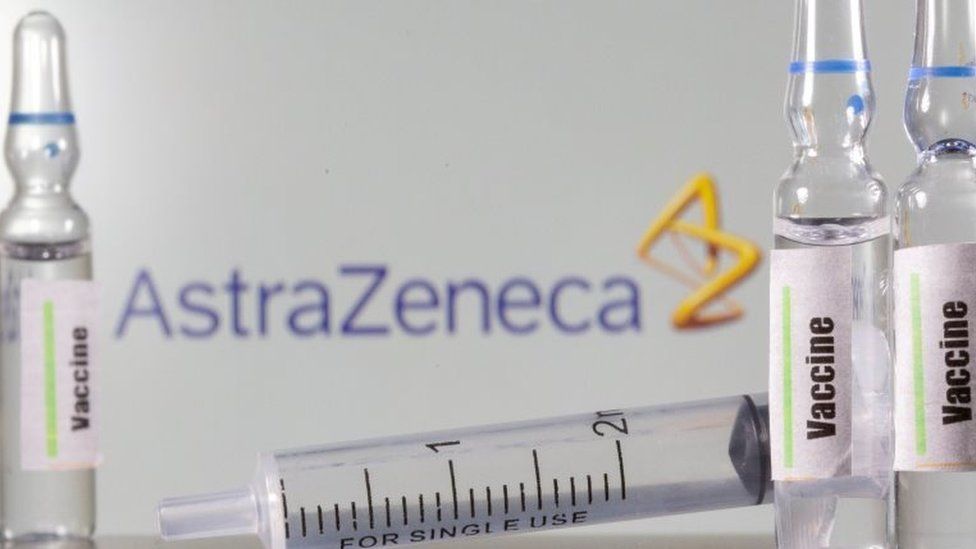
The EU has threatened to block the export of coronavirus vaccines to other countries such as Britain, after AstraZeneca was accused of failing to provide a satisfactory explanation for the huge shortage of promised supply in member states.
The pharmaceutical company’s new plans were said to be “unacceptable” after it “surprisingly” informed the European Commission on Friday that there would be a serious shortfall in the initial plan.
EU-AstraZeneca Contract
The EU was due to receive 100m volumes in the first quarter of this year. But it is feared that the bloc will only get half of that even though it buys a lot before the drug is approved by the European Medicine Agency.
In a heated exchange with AstraZeneca chief executive Pascal Soriot on Monday, European Commission president Ursula von der Leyen said the company must fulfill its contractual obligations. The EMA is expected to approve the vaccine by the end of this week.
A spokesman for Von der Leyen said: “She has made it clear that she expects AstraZeneca to implement the contractual arrangements identified in the pre-purchase agreement.
“She reminded Mr Soriot that the EU had invested heavily in the company in the past to ensure that the product was strong even before the conditional market approval was obtained by the European Medicines Agency.
“Yes, production issues can arise with complex vaccines, but we expect the company to find solutions and use all possible alternatives to deliver faster.”
EU’s Statement
EU Health Commissioner Stella Kyriakides made a statement on television expressing her frustration at the company’s behavior, warning that the answers so far had not been satisfactory.
Late Monday evening following discussions with representatives of the pharmaceutical company, Kyriakides wrote on Twitter: “Negotiations with AstraZeneca today led to dissatisfaction with the lack of explanations and clarity.
“EU member states are united: vaccine developers have societal and contractual responsibilities they need to uphold.
“With our member states, we have requested from [Astrazeneca] a detailed planning of vaccine deliveries and when distribution will take place to member states. Another meeting will be convened on Wednesday to discuss the matter further.”
These developments have put pressure on the commission as criticism and slow release of immunization programs in EU member states compared to the UK and US.
The UK has provided more than 10 doses per 100 residents but according to data collected by Airfinity, a London-based health science company, the EU has managed less than two doses per 100 residents.
Supply Chain And Logistics
Kyriakides said Brussels would now insist on being notified of any exports of vaccines from EU sites, including that produced by Pfizer on which the UK is reliant on European laboratories for supplies, raising the spectre of export bans.
She said: “You know that AstraZeneca vaccine is currently in the final stages of approval with the European Medicines Agency. If all requirements are met, the European Medicines Agency could recommend market authorisation by the end of this week.
“But there is a problem with the supply chain. Last Friday, the company AstraZeneca surprisingly informed the commission and its member states of the European Union that it intends to provide smaller doses in the coming weeks than has been agreed and announced.
“This new system is not acceptable to the European Union. That’s why I wrote a letter to the company over the weekend in which I asked some important and critical questions. The European Union has initially funded the development of vaccines and their production, and wants to see their return. ”
Kyriakides said the EU wanted to “know exactly what doses were produced by AstraZeneca so far. And if, to whom, they were donated”.
“These questions were also discussed today at the joint board of the commission with 27 member states and AstraZeneca,” she said. “The company’s response has been unsatisfactory so far. That is why a second meeting was scheduled for the evening. The European Union demands that orders and prepaid quantities be delivered as soon as possible. And we want our contract to be fully realized ”.
The EU has spent €2.7bn (£2.3bn) on the rapid development and production of coronavirus vaccines. Kyriakides said the commission had proposed that the member states agreed on “an export transparency mechanism be put in place, as soon as possible”.
Germany’s health minister, Jens Spahn, gave Berlin’s backing to the commission proposal. “We, as the EU, must be able to know whether and what vaccines are being exported from the EU,” he said. “Only that way can we understand whether our EU contracts with the producers are being served fairly. An obligation to get approval for vaccine exports on the EU level makes sense.”
Astrazeneca said in a statement that the company’s chief executive in his conversation with Von der Leyen had “stressed the importance of working in partnership and how AstraZeneca is doing everything it can to bring its vaccine to millions of Europeans as soon as possible.”

